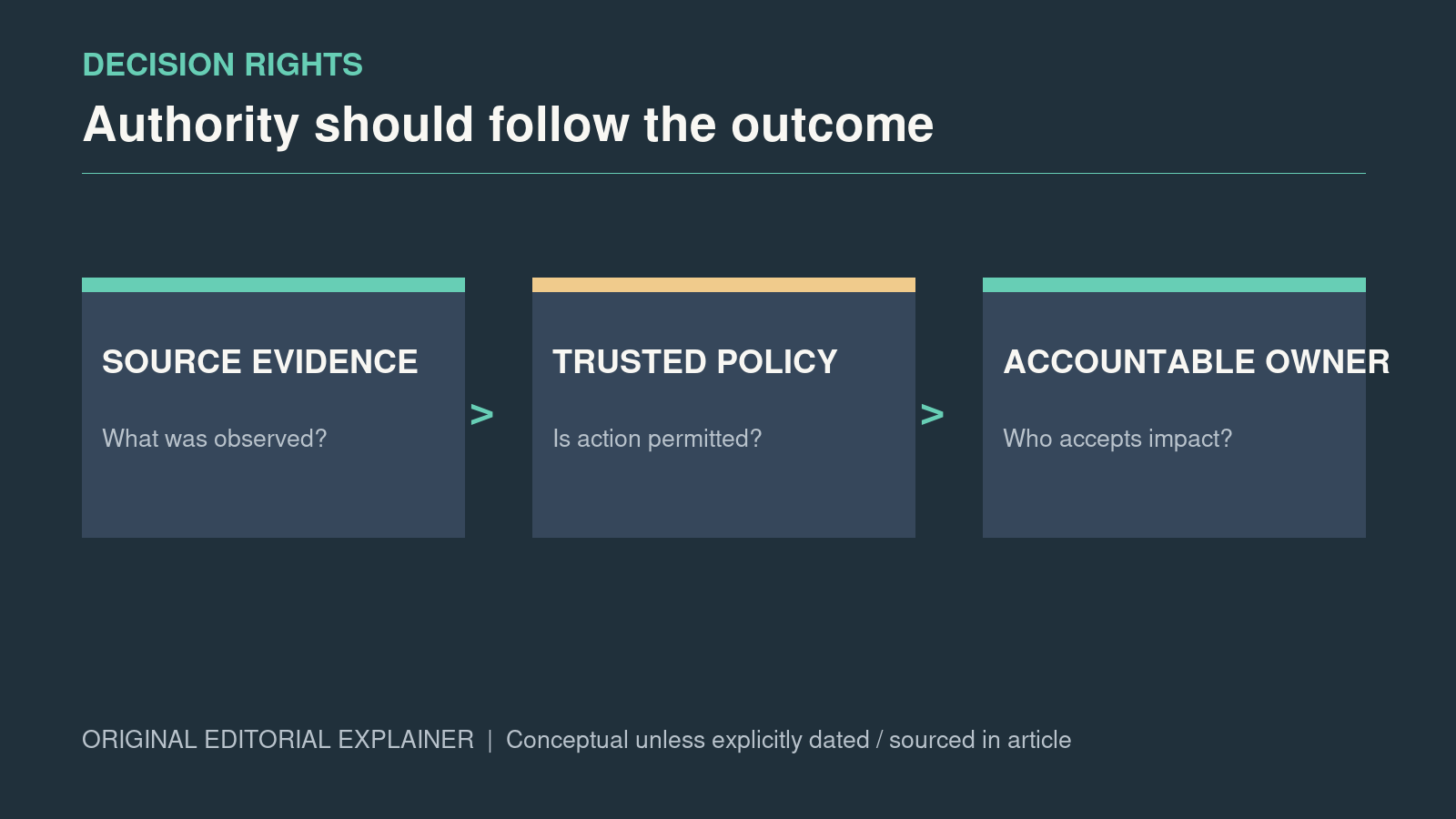
In an AI-native company, asking “Can the agent do it?” is an incomplete way to assign work. An agent may produce a customer response, modify a payment record or recommend a change in policy. Those operations differ in consequence, permission and reversibility. The important design unit is often not the agent, the department or the prompt; it is the decision that binds a business outcome to a responsible authority.
AI adoption is not the same thing as authority
The Stanford AI Index 2026 reports organizational AI adoption reaching 88% in its surveyed basis. That finding describes reported organizational use; it does not establish that 88% of companies have entrusted AI with unsupervised executive decisions or that all those uses have produced measurable economic gains. “AI-first” is a strategy description, not a substitute for a governance model.
The NIST AI Risk Management Framework presents four connected functions: Govern, Map, Measure and Manage. NIST’s model is voluntary and risk-oriented, but it gives a useful operating perspective: AI systems are social and organizational decisions as well as software integrations.
A decision-rights register for an AI-native team
| Decision | AI’s useful role | Who owns the consequence? |
|---|---|---|
| Draft a supplier negotiation | Extract offers, compare terms, prepare alternatives | A named buyer or procurement owner |
| Issue a customer refund | Gather evidence and propose an amount | Authorized operations owner and trusted policy controls |
| Move a production service | Compare environments and create a rollback plan | Accountable service operator or release authority |
| Publish a regulated claim | Find original sources, highlight uncertainties | Qualified editorial/legal approver where needed |
The specific approver may differ by company, but “the AI approved it” should not count as a recorded owner. A model’s explanation is not an authorization credential, and a successful demo is not sufficient evidence that the decision has a safe failure mode.
Separate preparation, recommendation and execution
Consider a wholesaler whose agent reads reorder reports and proposes a purchase order. A useful architecture records the source period, the proposed quantity, its uncertainty and the financial exposure. The agent can draft a purchase order without placing it. A trusted service then checks the supplier, price tolerance and budget, obtains approval at the required level and finally submits with a unique idempotency key. The reply may read “order submitted” only after the underlying purchasing system confirms it.
That separation sounds slower than a fully autonomous demo. It may be faster overall when compared with correcting duplicated orders, explaining an unauthorized discount or investigating a security incident. Not every small action requires a person in the loop; instead define which actions are reversible, low-risk and covered by bounded policy.
The review test that reveals a weak operating model
For any automation, ask five questions: Can we trace its source evidence? Can we tell who authorized the action? Is the business rule deterministic and separately enforceable? Can we retry without duplicate effects? Can we reverse or reconcile failure? If answers live only in a conversation transcript, the organization has not yet created a durable decision record.
There is also a commercial test: track actual cycle time, human review effort, rework, cost per successful outcome and avoidable loss. Count refused unauthorized operations as a successful control outcome, not simply a failed agent attempt.
What should change in the organization chart?
Not every role must disappear. AI may compress research and clerical throughput, but accountability for contracts, financial controls, safety and customer relationships remains real. The organization can reduce handoffs by giving a single person or team explicit ownership of an outcome while using models and tools underneath. In that design, “executive” describes authority to accept a consequence—not an ability to generate a convincing memo.
The better question for a leadership team is therefore: Which decisions can be encoded as narrow verified policies, and which still require informed human judgment? Answering it task by task produces a credible automation roadmap.
References and boundaries
Stanford HAI AI Index 2026; NIST AI RMF Core, Govern/Map/Measure/Manage. The supplier example and decision register are proposed organizational designs, not claims from a field-tested enterprise or quoted company interviews.